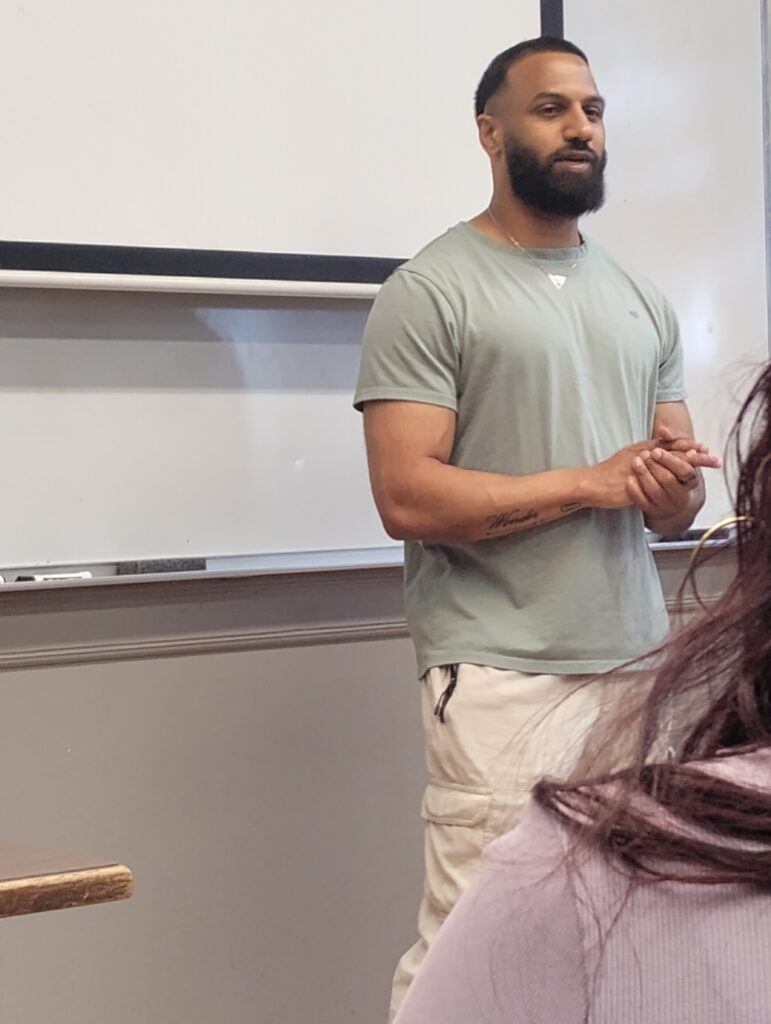
On an April Monday, Joy Damiani made presentations to four classes at a Manhattan transfer high school. Read Joy’s reflections on that visit here. You can also see some student comments about the visit from our evaluation form here.
On another day, Joe Urgo did a presentation to a college class at one of the public campuses in NYC. It led to a wide-ranging discussion in which students made a number of profound comments.
After viewing a short film on the Winter Soldier hearings, which Joe had helped organize, and talking about how when crises happen, young men line up at recruiters, one male student responded that he always thought that if some such thing happened he would join the Marines but added, “I’m not doing that if it means becoming like that.” Another young man stated, “I’m not joining up after what this country has done to my people.” A female student remarked that she was not surprised by the film because with all going on right now in the world, all the bad things, anything is possible. Another young woman added she was not surprised by the film because “I come from another country and the people in my country know the truth about the U.S. wars.”

Next, we were off, via Zoom, to a community college in North Carolina where Ross Caputi spoke with three psychology classes (watch video above). The professor wrote us after saying,
Ross, your presentation today was truly spot on. You delivered a powerful and necessary message in a way that was both gentle and deeply compassionate, creating space for reflection without alienating your audience. What stood out most was your willingness to clearly and directly address U.S. foreign policy. You illuminated how these policies not only create harm abroad, often with devastating human consequences for innocent populations, but also carry serious implications for the well-being and moral integrity of our own nation. That is not an easy truth to communicate, and you did so with clarity, courage, and respect. Thank you for the meaningful work you are doing and for sharing it with our students.
And thank you, Stephanie, for bringing these exceptional voices to our campus and your continued work with We are Not Your Soldiers.
Our next stop was back in-person again with Shaniyat Turani-Chowdhury speaking to a philosophy class at a local branch of the public university.
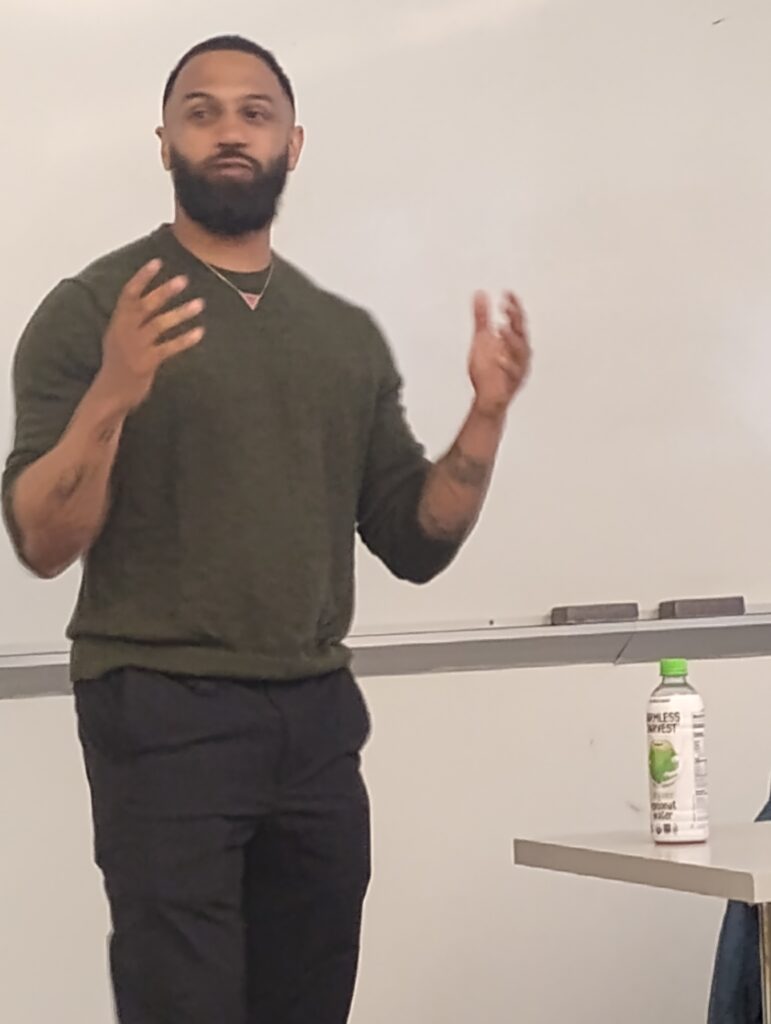
The following night Shaniyat spoke with more students from that school, along with students from a local community college, who are all taking the course asynchronously. Nearing the end of his remarks about why he enlisted, his experiences in Afghanistan and his transitioning back to civilian life, he said:
Education’s been a big part of my journey, being around educators, artists, and having them share their stories, being able to listen and sit with it, share their stories. And they want you to be able to tell the stories to others. That’s what helps inform not just consciousness on world politics, but how exactly we engage with the people around us, the institutions around us. Thinking about where you want to be, what you want to do after you graduate, thinking about the job prospects.
I went back to grad school — after graduating John Jay, I went to NYU. I just got my master’s in international relations last year. I also had that dilemma of having to choose between either working for, let’s say, the UN, or making a decision about working for, like, a weapons manufacturing company. These are things that we may not think about because if you serve in the military, you directly are contributing to the war. But then, even in being in these other positions, you could be joining employers who are contributing to war, right? They’re making the weapons, they’re shipping weapons, and I had to ask myself, do I want to be a part of that? And so instead of doing that, I decided to go with something that had just sat with me. I’ve always carried stories, shared stories, so I transitioned into journalism.
Over the last two to three years, I’ve traveled to Palestine, Lebanon, most recently just came back from Cuba a few weeks ago prioritizing foreign policy, how exactly U.S. foreign policy impacts the native peoples of the countries that we’ve been either colonizing or invading. While doing that, I also feel fortunate to be able to come into classrooms and speak with students who feel that sometimes the military might be the only way out. I’ve spoken to students, with We Are Not Your Soldiers, where we go to college campuses, high schools, and students are having to make those tough decisions of whether the military career is a path for them because they want stability. It’s like a natural feeling because we all want stability, we all want to make sure our families are taken care of, but at what cost?
I’m going to stop right there. I love being in these spaces, because I’m hoping that’s just something that you guys are able to carry with you, conversations that you have with the people around you, having the same conversations that I wish other people would have had with me. So, feel free to ask any questions. And there are probably going to be other stories that come up along the way, so I might just, share some along. Let me know.
We ended the week, and the month, with a wonderful visit to a college, again in NYC, where Shaniyat engaged in a lively discussion with the members of the Palestine Solidarity Network!