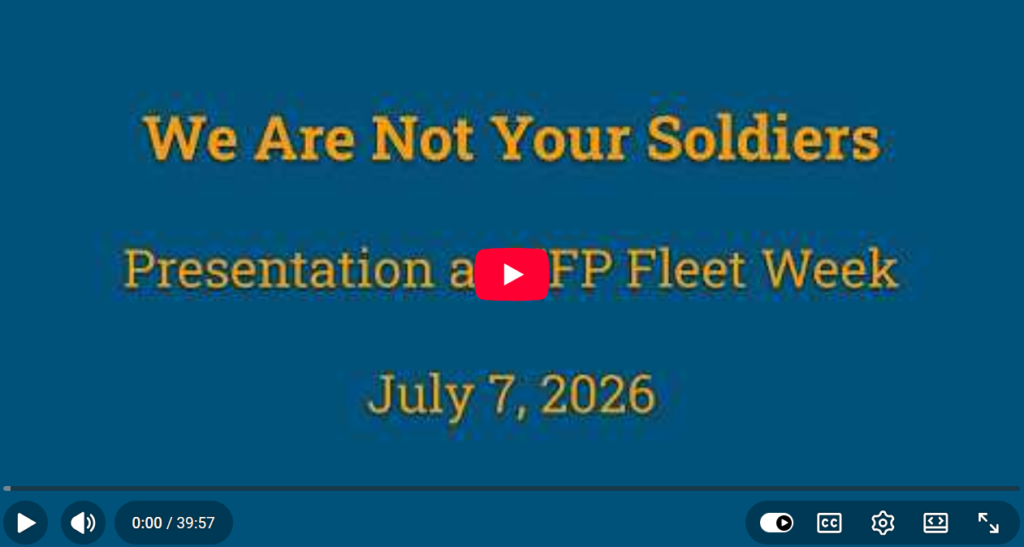
You may have heard previously about the We Are Not Your Soldiers presentation at the event organized by NYC Veterans for Peace for Fleet Week, held on July 7. Hideko Otake filmed the presentation so we’re sharing that with you now.
If you’d like clearer views of the videos shown in the presentation above, click each of the following links:
- Short clips #1 – 5 minutes
- Short clips #2 – 6 minutes
- Ross Caputi – full video (only 3 minutes of which are in presentation above)
- Shaniyat Turani-Chowdhury – full video (only 3 minutes of which are in presentation above)
________________________________________________________________________________________________________
We are fortunate that one of the professors whose classes we visited in April shared with us this summer the papers written by her students following presentations. We now would like to share one of them with you. You can read excerpts from others here on our website.
The presentation by Stephanie Rugoff and Shaniyat Turani-Chowdhury from We Are Not Your Soldiers offered a powerful critique of military recruitment and the larger system that supports war. Rather than presenting military service as a straightforward path to opportunity, the speakers encouraged students to think critically about why young people are drawn to enlist and what the real consequences of that choice can be. The talk was especially effective because it combined personal experience with larger political and moral questions. It was not just informative; it was meant to challenge assumptions and push the audience to reflect on issues of power, violence, and responsibility.
One of the most important things I learned from the presentation was how recruitment often targets people who are already facing hardship. In the discussion, Shaniyat Turani-Chowdhury described growing up in Queens in a poor environment, feeling pressure to support his family, and seeing the military as a practical job option rather than a political decision. He explained that advertisements and recruitment messages can make enlistment seem like a way to gain benefits, money, and respect, even when the reality is far more complicated. That part of the talk showed how the military can appeal to young people by promising stability while leaving out the broader human cost of war.
What I found most interesting was the way the speakers connected personal identity to military service. Turani-Chowdhury spoke about being Muslim after 9/11, facing racism and suspicion, and feeling that joining the military might offer acceptance or a sense of belonging. What surprised me most was that it revealed how enlistment can be shaped not only by economics but also by discrimination and the desire to prove oneself. In other words, people may join for reasons that have less to do with patriotism than with survival, identity, and social pressure. This made the presentation feel much more human and complicated than a simple anti-war argument.
Another striking part of the talk was the emphasis on the consequences of war for people on the other side. Turani-Chowdhury described meeting a young Afghan boy who had lost family members and whose life had been permanently damaged by the war. That story made the effects of military action feel immediate and personal instead of abstract. He also discussed the enormous cost of the wars in Iraq and Afghanistan, estimating that more than a million people were killed and that the wars cost approximately $6.8 trillion. Those numbers were surprising because they show the scale of destruction in both human and financial terms. The presentation made it clear that war does not only affect soldiers; it shapes the lives of civilians, families, and entire societies.
My analysis is that the strongest part of the presentation was its refusal to separate military service from morality. The speakers did not treat service as automatically heroic or immoral, but instead asked the audience to examine what the military is used for and who pays the price. That approach matters because many students hear only the positive side of recruitment: tuition help, steady pay, and job training. The talk balanced that narrative by showing the emotional, ethical, and political realities that recruiters often ignore. It encouraged me to think of military recruitment as a system that often depends on inequality, fear, and limited options.
Overall, the presentation was memorable because it was honest, personal, and unsettling in a productive way. It taught me that war is not an abstract issue that happens far away; it is tied to the choices a society makes about money, power, and whose lives matter. Most of all, it showed how important it is to listen to veterans and former service members who are willing to speak openly about what they experienced and what they learned. Their perspective can help students question easy answers and think more carefully about the real meaning of service, sacrifice, and peace.
Your support means a lot for us as we look forward to an active Fall semester. As school hasn’t even started yet, we haven’t even begun our outreach to educators. But, we’ve already received two exciting invitations — one to facilitate a Q&A to two college student organizations doing a military-connected film screening and another to three community college classes. Your contributions make all this possible as educators, students and schools are not charged for our presentations. Aside from our very minimal operating expenses small stipends are given to the veterans who speak.