By Michael “Lefty” Morrill
From Substack | Original Article
History does not always announce itself with cannon fire. Sometimes it clears its throat in a clerical voice, wrapped in liturgy and law, and says something quietly heretical.
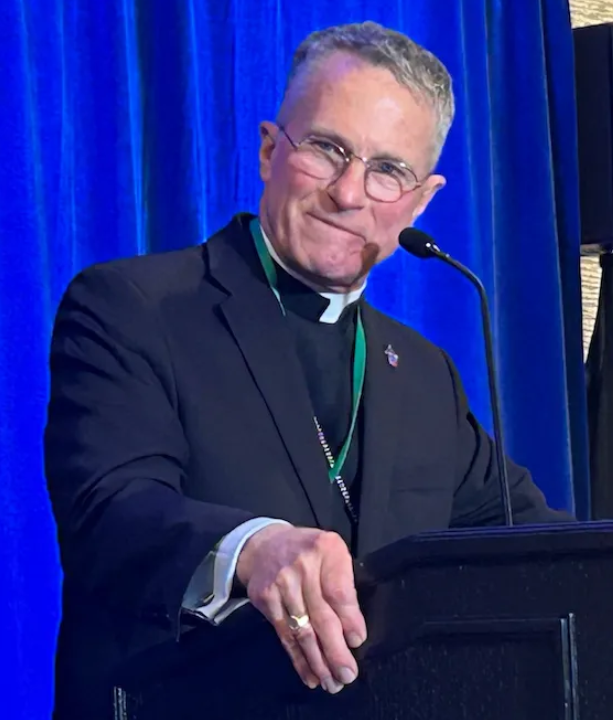
When Archbishop Timothy Broglio, the Catholic Archbishop for the Military Services of the United States, suggested this week that American troops could morally refuse orders to invade Greenland, he did more than comment on a hypothetical war. He tugged at a loose thread in the fabric of empire, and revealed how much depends on everyone pretending that thread does not exist.
The language he invoked belongs to an ancient tradition: Just War theory, a doctrine older than the United States, older than the modern nation-state itself. It was forged in the uneasy workshops of Saints Augustine and Aquinas, men who tried to reconcile the violence of the world with the demands of conscience. War, they argued, could only be just if it met strict criteria: a legitimate authority, a just cause (usually defense), proportionality, last resort, and a reasonable chance of success. These were not permissions to kill. They were restraints, meant to make war harder, not easier.
Over time, however, Just War theory has been hollowed out, weaponized, and reissued as a moral rubber stamp. Preemptive wars are renamed “defensive.” Resource grabs become “security interests.” Civilian deaths are folded into the antiseptic phrase collateral damage. The theory survives mostly as a prop, invoked ceremonially, like a prayer muttered before the bombs fall.
Broglio’s intervention disrupts that ritual. By stating plainly that he sees no conceivable just cause for invading Greenland, he restores the doctrine’s original function: to say no. Not to advise caution, not to suggest better planning, but to deny moral legitimacy outright. In doing so, he reminds us of a truth modern warfare desperately wants us to forget: an illegal or immoral order is not sanctified by hierarchy.
This is where his remarks become genuinely dangerous: to power, not to peace.
The United States military is built on obedience. Not merely discipline, but the near-sacramental belief that orders flow downward cleansed of moral residue. Responsibility, in this model, dissolves as it ascends. The soldier pulls the trigger; the general signs the plan; the president invokes national interest. Guilt evaporates somewhere above the clouds.
History, inconveniently, disagrees.
After World War II, the Nuremberg Trials shattered the myth that “following orders” absolves moral responsibility. Crimes against humanity, the tribunal declared, cannot be laundered through chains of command. This principle is now embedded in international law, in military codes, and—rarely acknowledged—in the quiet training manuals that tell soldiers they must refuse unlawful orders.
But such refusals are treated as theoretical anomalies, never as living possibilities. Broglio breathes life back into that possibility. He speaks not only of legality, but of conscience, that unruly interior territory that empires cannot fully map.
The United States has not been kind to conscience. From Vietnam to Iraq, from My Lai to Abu Ghraib, those who refused, exposed, or resisted unjust wars were punished, ridiculed, or erased. Whistleblowers become traitors. Objectors become cowards. Memory itself is disciplined.
And yet, the record is clear. The Vietnam War—sold on fabricated incidents and abstract fears—collapsed under the weight of its own immorality. The invasion of Iraq, justified by lies about weapons of mass destruction, shattered a country and destabilized an entire region. Afghanistan, the “good war,” ended not in victory but in quiet evacuation and strategic amnesia.
Each time, the criteria of Just War were invoked after the fact, as an exercise in damage control rather than moral foresight. Broglio’s statement reverses that order. He speaks before the war, before the body count, before the excuses are needed.
Why does Greenland matter? Not because an invasion is likely, but because the idea of it exposes the logic of empire in its most naked form. Greenland is strategically valuable. It is resource-rich. It sits at the crossroads of Arctic militarization in a warming world. To even joke about invading it is to confess that alliances are conditional, sovereignty is negotiable, and might remains the final argument.
Broglio refuses that logic. More importantly, he refuses to outsource morality to the state. In doing so, he places the burden where it belongs: on the individual human being asked to commit violence.
This is not romantic pacifism. It is moral realism. He acknowledges that refusal carries consequences: that a soldier who disobeys may face punishment, isolation, ruin. Conscience, he implies, is costly. But it is not optional.
In an age where war is increasingly automated, remote-controlled, and narrated in the language of efficiency, to speak of conscience is to reintroduce friction into the system. It slows the machinery. It asks questions no one wants answered. It reminds us that war is not an abstraction but an accumulation of individual acts.
That is why this moment matters. Not because a bishop spoke, but because he spoke to soldiers, and told them they are not empty vessels. That they are not absolved in advance. That they remain moral agents even when wrapped in flags.
Empires depend on silence more than force. They depend on everyone agreeing not to look too closely, not to ask whether a given war is necessary, legal, or just. Broglio’s words crack that agreement.
Whether they will echo beyond this moment is uncertain. History is adept at absorbing dissent and continuing on its way. But sometimes, a single refusal, a whispered no in the cold, changes the story.
Conscience is not loud. It does not march in formation. But it has a long memory. And occasionally, it speaks through unexpected mouths, reminding us that the most subversive act in an age of endless war is not protest, not analysis, not even outrage—but refusal.
____________________________________________________________________________________________________________
And, related, from Veterans for Peace:
Paratroopers Readied for Minneapolis Might Just Say “Sir, No Sir!” — Fairbanks Air Force veteran has informed them for 18 months they can refuse illegal orders
FAIRBANKS AK – Some 1,500 paratroopers from the Army’s 11th Airborne Division at Fort Wainwright are on standby for immediate deployment to Minneapolis. Many of them will have seen the signs and read the flyers a military veteran has taken to base gates since July 2025, telling them “REFUSE ILLEGAL ORDERS. IT’S THE LAW AND OUR DUTY!”, “THE PATH TO FASCISM IS PAVED WITH ILLEGAL ORDERS!” and “SIR, NO SIR!” the title of a documentary about GIs who refused to fight in Viet Nam.
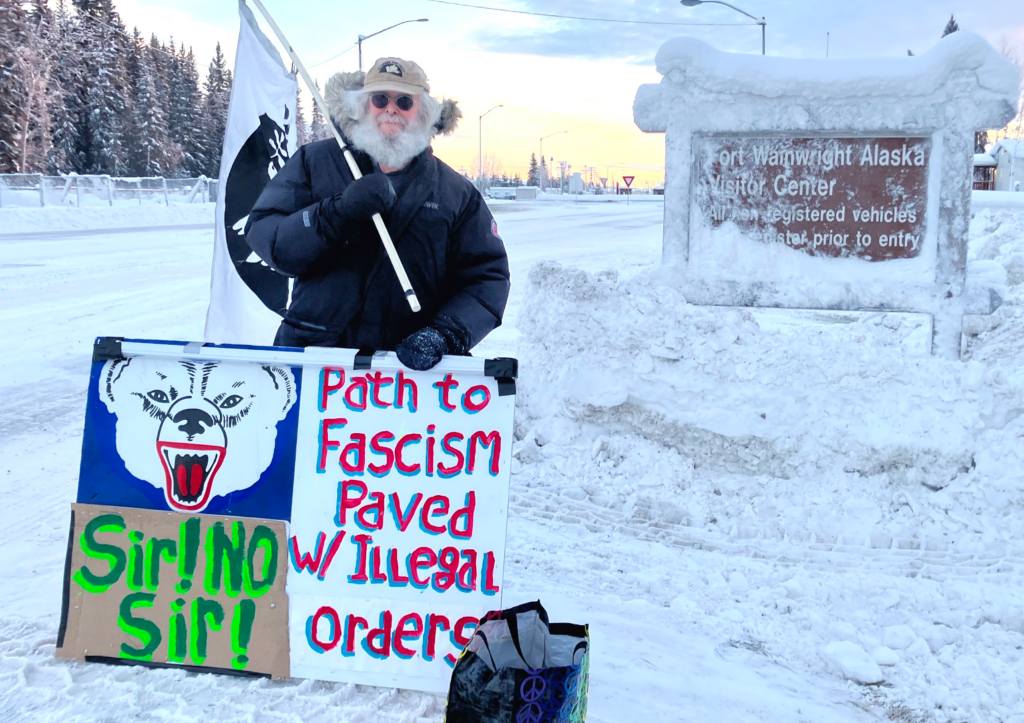
Rob Mulford, a 73 year-old Air Force veteran, has maintained his monthly vigil outside Ft. Wainwright, near Fairbanks, with large signs and literature dozens of paratroopers have taken inside. His flyers have included phone numbers for G.I. rights counselors prepared to advise troops questioning orders to support Israel’s genocide in Gaza or arrest U.S. citizens domestically.
Mulford, who also spent five years in the Army National Guard, is a member of Veterans For Peace. He considers it his duty to inform young, active-duty soldiers that the oath they took to defend the Constitution does not include breaking the law, no matter if the Commander in Chief orders them to do so.
Explaining his motivation, Mulford paraphrased labor organizer and socialist presidential candidate, “Like ol’ Gene Debs, I’ve come to recognize my kinship with all living beings. I am convinced I am not one bit better than those living under the most wretched of circumstance. As long as there is an underclass, I am in it. As long as there is a criminal element, I am of it. As long as there is a soul in prison, I am not free. And, as long as there is a class that profits in the making of war against any of my relatives, I will fight them nonviolently until I draw my final breath.