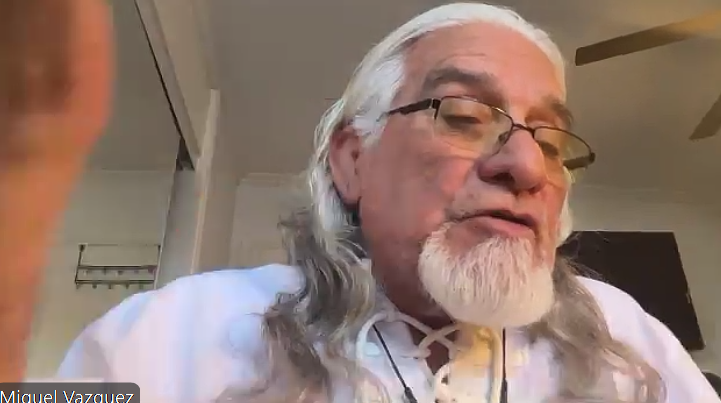
Excerpts from a Zoom presentation by Miguel Gabriel Vazquez to high school students in NYC in May 2025. The students had recently read The Things They Carried by Tim O’Brien.
I’m a Vietnam veteran, survivor of that war and of the post-traumatic stress that I brought home with me. I came back very confused and very disoriented, wondering what the hell happened. When I was 19 years old, I had received my draft notice. The draft was an Involuntary induction into the military, usually the Army because the Army was the main two-year branch, but also you could be inducted into the Marines or you could choose to go into the Marines at that time if you were drafted.
I had dropped out of college for one semester to help the family and I got drafted because I wasn’t in college. I went to Fort Bliss, Texas for training, an experience within itself. The draft was pretty urgent for them at that time. They wanted more bodies, more people to go to Vietnam. More than half of the men in my graduating class from high school were drafted.
Later, I became a psychologist who specializes in veterans’ trauma.
Student Question: Did you have anything with you when you were in the war that reminded you of home?
What I tell people is that I brought to war my Mexican heart. To me that meant my father was a farm worker, a very pastoral peace-loving, conscientious person and also a conscientious objector. I brought my consciousness in my Mexican heart, which meant that I was a humanitarian. I used to listen to music, like Joan Baez, protest music but a lot of the guys would criticize me. So, I brought with me to Vietnam my conscience and my loving heart to try to survive, to have them help me survive, to adapt to that situation.
The rice paddies reminded me of home, because my family were farm workers, we were migrant farm workers. Then I saw the way that most of the Vietnamese farmers were treated by a lot of the American troops. And that reminded me of how we were treated when we were kids, so in a lot of ways, I related more to the Vietnamese peasants than I did to some of my own brothers in arms. Because racism is a very real thing, and it was very very evident.
So to answer your question, I took with me my attitude, my perspective of what was right and what was wrong and that’s what I used to call my Mexican heart.
That brings us to the moral part of this. And when I say what’s right and what’s wrong, I mean what’s morally right, what’s humanitarian, what is good for humanity, what is good for you and me. Those are the things that I’m talking about.

Student question: What was your job in the Army and how long were you in?
All of us had our jobs. My job was combat engineer, power plant operator, and my other job was to carry my M16 and be a soldier. My tour of overseas duty was actually 10 months, 29 days, 4 hours, and 35 minutes to be exact. That was my time and that was enough, believe me.
Student question: A lot of soldiers come home with PTSD? You have been talking about moral injury also. Are they related?
Moral injuries are pretty much when we are either forced or coerced, or seduced into doing something we don’t want to do that’s against our morals, our moral values, our moral standing, our moral perspective.
As a naive country Mexican Catholic when I went to Vietnam, still believing in the Ten Commandments I was pretty shocked. It took me a while to just adjust to what I had to do to survive there. And, it got even more complicated when I came home because, from my perspective, they taught us how to go to war, but they didn’t teach us how to come home.
We had a hard time readjusting and that’s why a lot of veterans get very sick from post-traumatic stress. The suicide rate for veterans is one of the highest in the nation for anything. They say it’s 22 per day but it may actually be quite a bit higher.
People that have PTSD usually have a very tight fuse, a very short fuse. We don’t have a lot of patience when we’re that upset, because the moral injury is always gnawing away at us.
I don’t know if you guys have ever heard the term hypervigilance. Hypervigilance is the fight-flight syndrome, the fight-flight reflex. It’s when you’re triggered by fear and your body prepares itself to either fight or flee. When you have combat PTSD especially, you get stuck there more often than not. It’s very hard for people to help you because you don’t want to hear what they have to say. And sometimes, if they say the wrong thing, you jump all over them. It’s difficult. You need a therapist with a lot of patience.
Without love, you have a harder time finding the worthiness to heal, because you need to feel worthy, you need to feel that you’re worthy of healing.
I’m going to read you a textbook definition of moral injury, okay? So you know what it is and what we’re talking about.
“Moral injury is a lasting psychological, spiritual, behavioral or social impact that can result from witnessing, failing to prevent or engaging in acts that violate one’s moral beliefs or values. It’s a trauma syndrome that can include psychological, existential, interpersonal, and behavioral issues. While most research has focused on military veterans, moral injury can occur outside of the military context.”
Moral injury starts in the military in basic training. They used to call it brainwashing but they got in trouble for calling it that, it’s not for the public, but for their eyes only. So they changed the wording to conditioned helplessness, or learned helplessness, which amounts to the same thing as the brainwashing. They want to make sure that we, the recruits, the boots, the people that are in basic training become totally subservient and obedient and drop our attitudes, stop thinking for ourselves, and just do what we’re told. We were actually yelled at. They got in our face. The second year, I was shipped to Vietnam.
Student question: Is there any way to be helped with PTSD or moral injury?
There are five critical self-judgments that are bad: resentment, fault, guilt, shame, and blame. We all practice those to our dismay, to our disadvantage. We need to let go of them and practice truth, love, forgiveness, and gratitude in order to fulfill to fill ourselves with positive energy and the energy of positive change. We can do that by accepting what is, accepting the truth, living in the now, living in the present.
A lot of veterans have to learn that. A lot of people in life have to learn that. A lot of women veterans have a hard time, too, because they had all the issues that the men had and then they were also sexually molested or raped. It’s a hard, hard thing. It’s hard not to take it personally.
Student question: As a Mexican, did you experience racism?
There were so many things that caused a lot of culture shock, and when I first went there, I felt comfortable in a way, because I saw a lot of the rice paddies, I saw a lot of the workers out there were farm workers. They were tending their rice. They were working with animals. They used the oxen that were pulling their their equipment in the fields and they carried stuff on big cows and oxen. I related to them, and what little we could communicate.
But it was obvious to me also that a lot of the American soldiers didn’t relate to them very well because they were foreign, and they didn’t speak English. The attitude reminded me sometimes of the attitude that we felt in East LA and sometimes when we were in the fields, the racist attitudes of a lot of the wealthy Americans showed myself and my family.
So it was confusing. At the same time, I was trying to find the good in it, because I like people, I like meeting other people. But then we started getting more and more into conflict, into actually being bombed and losing people, so you start to develop the fear of dying, the fear of seeing other people die.
Student question: What was the worst experience you had in Vietnam?
It wasn’t very long before, about two months in, when I had a really really bad experience. I had two friends who went AWOL, Singleton and another guy. They went to R&R in Hawaii, that’s our leave time. They went, and from Hawaii, they went home to the mainland U.S. somewhere. And they got caught. These guys had been together, been friends since kindergarten, they met in kindergarten, they went to grade school together, went to high school together, got drafted after high school together, went to Vietnam together and they went to R&R, and they went home together. They went AWOL. They got caught.
And they were brought back together. That night, we were talking and drinking beer and we were getting a lot of education, because these guys in the two weeks that they were away had learned a lot. We were in a combat zone, we were being told that we needed to kill people. But these two guys were very committed to going home and being anti-war activists.
The next morning, at 6:00 am, we got the first rocket hit right by my hooch, what we called our buildings. It was an airburst, it hit a tree, so a lot of people got up and ran towards the bunkers. I got up and started to run, but then I heard the thud of another rocket coming out of a container, out of a tube, so I hit the ground. A rocket hit very close to a lot of the guys. I got up, started running again. I saw Singleton coming from my right, we were both going for the hole. I ran a little faster and jumped feet first into the hole. Right as I jumped in, another rocket hit, right between Singleton and myself. I thought I had been hit in the face. I grabbed my face, because it burned and I got up and started running again. The guys were looking, the guys were already in the bunker. Then we heard Singleton crying out for help. He obviously did not make it past the falling rocket so I started to go out. One of the guys grabbed me. He said, “Fool, there’s all kinds of rockets coming, they’re falling, like, every 20 seconds.” We used to count how far in between they were. When he grabbed me and pulled me down, one hit right outside. If he hadn’t grabbed me, I probably would have walked right into it. I waited a little while but I couldn’t stand hearing Singleton yelling out for help, yelling to God, yelling for anybody that could help. So I went out.
To make a long story a little bit shorter, that was one of the most traumatic of the whole time that I was there. He was still alive and talking, but his body was dismembered. I was trying to help him and calling for a medic. We wrapped him up and put him in what they called at the time the meat wagon, a makeshift truck that was made into an ambulance. By this time, a couple of other guys came out.
Most of the officers did not come out to help us. I jumped into one of their bunkers. The officers were inside the bunker. I yelled, “What the fuck are you guys doing here? The guys out there need you.” They just looked at me and shook their heads. They didn’t say anything, so I went back out with a lot of the other guys, guys like myself.
We were out there helping them and we picked up seven guys. We were told later that they all died. Some were so wounded that they bled to death. That included the two guys who had gone AWOL and were returned the day before.
That was a really very traumatic experience which changed my whole life because you try to make sense of things. If you break your arm, you set it. It might be traumatic, but eventually you get over it as the arm heals. The cast comes off, you get on with your life, you can probably use your arm the same way you used to. But with moral injuries, it’s different. Moral injuries stay with you.
Student question: What was the purpose of the war?
Well, it depends on who was looking at the war. According to the to the government, we were all serving the purpose there. But I know the purpose I was sent there for. We were indoctrinated by telling us, giving us the rah-rah speech of how we were protecting democracy, God, and country. Any honorable young man is going to accept that. And so we thought we were creating that energy to fulfill that purpose.
But once we started wising up, we started being a little bit more open to other ideas. Most of us realized that that wasn’t the whole thing. We didn’t understand what it was.
I understood more after that one conversation of the story I told you of the two guys that died the next morning, of the two guys who just came back from R&R, the energy that they were feeling, They just were sponges to all the people who were anti-war at home, because almost everybody was. And they came back and they taught us that.
And that made me realize that my purpose was to help other guys understand that we had to play the game long enough to come home which was very difficult to do. A lot of the guys were getting in trouble because they were just totally defiant. They were drinking too much, so they were being dangerous to themselves and to the rest of us because it was hard to understand that we had been duped, that we shouldn’t even be there.
And those are the causes of the moral injuries: to fulfill the purpose of the government, not the purpose of humanity, not the purpose of myself, my family. It was a bunch of poor kids, working-class kids, that were sent over to a country we didn’t even know to kill other poor kids from that country. We had no stake in the wealth of the leadership. Now it’s pretty obvious.
It’s black and white who the leaders are and what their what their intentions are. It has nothing to do with helping humanity, has nothing to do with helping working class people, especially working-class people of color in our country that’s supposed to be of the people, by the people, and for the people. That’s bullshit. It’s never been that way. The administration of justice has never been equal since I’ve been alive. I’m sorry, I’m not sorry, I’m being frank, I hope nobody’s offended because I think the truth needs to come out and the truth needs to be told.